

Early 2025. ECS Group / QUITO, an air-freight consortium: 1,600 employees worldwide, one billion euros in revenue, 160 subsidiaries, around a hundred people at headquarters. The Group's founder expects a structured AI roadmap, to justify an efficiency trajectory to investors and to identify the real business drivers that can be activated across the 160 subsidiaries. Three other firms are competing, including a Big 4. And Catalia.
The threat no distributed group ever sees
The AI transformation industry in 2024-2025 built a dominant narrative for large groups: standardize processes before you industrialize AI. The reasoning sounds airtight. If every subsidiary has its own rules, its own KPIs, its own tools, then you have to unify first before you can roll anything out.
ECS Group / QUITO was the perfect embodiment of what this doctrine treats as a problem. 160 subsidiaries born from successive acquisitions and consolidations, with heterogeneous practices. No consolidated KPIs. No process standardization. Data scattered in silos. Around a hundred people at headquarters who spend their time treating each subsidiary as an exception.
The Group's leadership read this setup as an unsolvable weakness. We can't standardize anything, so we can't industrialize anything. That is the diagnosis most firms would have validated before proposing an eighteen-month standardization program.
Catalia took the opposite stance. What humans treat as 160 unmanageable exceptions, generative AI handles very well as 160 personalizations. One contextualized instance of the same technology base for each subsidiary, rather than a single model forced on everyone.
This cognitive inversion unlocked ECS Group's AI agenda. The 160 subsidiaries are no longer the problem. They are the playing field.
Why Catalia, competing against three other firms
The founder of ECS Group / QUITO selected Catalia over three other firms, one of them a Big 4. Three explicit factors tipped the choice.
First, Catalia is a pure-play AI firm. Not a generalist firm with an AI practice bolted on, but a house that is 100% specialized on the subject, which produces a level of expertise that diversified firms cannot hold.
Then, the executive and Matthieu Sabourin had already worked together, along with the Group's CSR lead at the time. Existing trust to draw on, with no mutual discovery phase.
Finally, the timeline. ECS needed a roadmap in three weeks, not three months. Catalia held that deadline on an engagement led by a senior founder, where a Big 4 would have staffed six people for three months at a budget five to ten times higher.
Week 1: international interviews and gathering the material
More than twenty interviews conducted in the first week, in French and English, with ECS employees across every country where the Group operates:
- The full executive committee of ECS Group / QUITO,
- The subsidiary leaders in the most structurally important regions,
- Operational leaders on the ground: the people who run the processes day to day and know where the friction is.
This stratification is deliberate. An AI audit run with the executive committee alone produces a strategic report disconnected from real friction. An audit run with the ground alone produces a list of tactical use cases with no strategic anchor. Catalia holds both levels at once. That is what produces the depth of the readout.
Every interview was recorded and transcribed, the transcripts added to the audit corpus alongside the Group's internal documents and the reports from the workshops run in parallel.
Week 2: workshops and the architecture of an AI-augmented audit
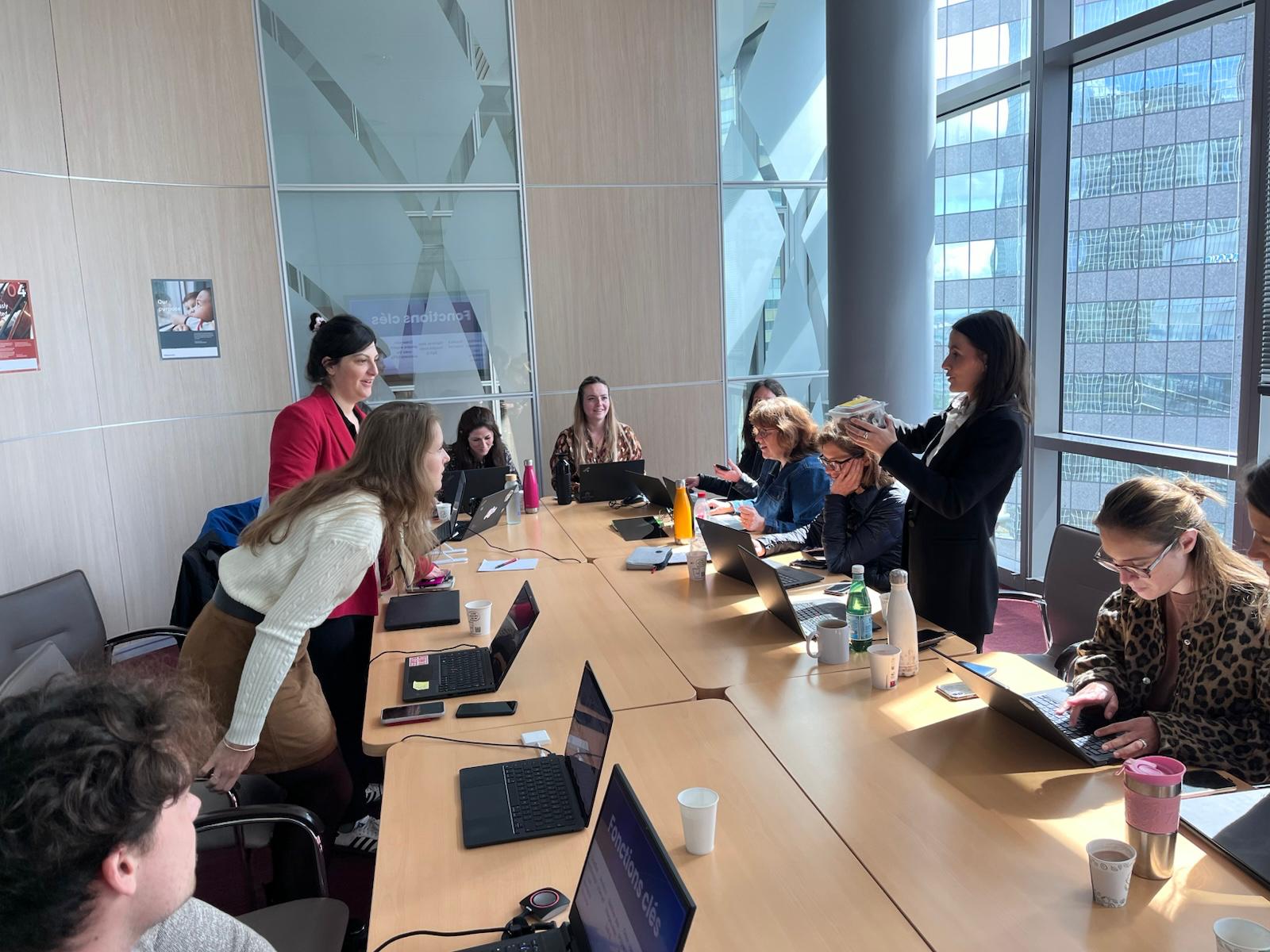
Three workshops run with mixed compositions: leadership teams and operational staff in the same room, to confront the visions and surface the real blocking points. Running the workshops drew on the Design Thinking techniques Catalia has deployed for ten years, adapted to strategic AI framing.
During the same week, Catalia built a RAG audit chatbot for the engagement, fed in real time by the mission corpus: interview transcripts, workshop reports, ECS internal documents, all the Group knowledge accumulated over the first two weeks.
This setup is what let Catalia, in two weeks, cross-reference interviews conducted in different subsidiaries, identify recurring patterns invisible to the human eye, and produce an analysis a traditional team would have delivered in two months. Catalia did not just audit ECS Group on AI. Catalia audited ECS Group with AI, demonstrating live the method it was preaching.
The material was analyzed through Catalia's 5C method: a proprietary grid that frames every strategic AI engagement along five complementary axes, making sure no critical dimension of the transformation is left out of the diagnosis.
Week 3: 2030 vision, top 15 use cases, 12-month plan
Deliverables handed to the executive committee at the end of week 3:
- 50-page audit report + executive summary
- 2030 strategic vision: ECS Group's AI positioning six years out, calibrated on the investor narrative and on the strategic posture recommended to drive the transformation
- 15+ qualified priority use cases (cross-functional, headquarters support functions, frontline roles in the subsidiaries)
- Top 3 launched immediately after the report was handed over (detail below)
- 12-month transformation plan structured by milestones
- A benchmarked list of the AI startups relevant by function, to help ECS choose its technology partners without locking Catalia in as sole integrator
- The RAG audit chatbot itself, handed to the client at the end of the engagement
The moment that says what the engagement really produces
Presenting the audit report and the executive summary to the ECS Group / QUITO executive committee marked the team for two reasons.
Speed, first. Three weeks to produce this level of analysis, when the competing firms were asking for three months. This is no sleight of hand, it is the direct result of the combination senior pure-play AI + AI-augmented audit + Design Thinking workshop facilitation.
The cultural read, next. ECS Group / QUITO is a group born from successive mergers and acquisitions, an aggregate of entities bought, consolidated, distributed worldwide. The usual frustration for executives is failing to harmonize. Our read flips that frustration into a strategic advantage: precisely because ECS is a heterogeneous aggregate, it is excellent ground for the hyper-personalization that generative AI makes possible. What classic standardization fails to solve, AI solves by the opposite route.
That read is what flipped the executive committee's agenda during the readout.
The Top 3 launched immediately after the engagement
ECS Group / QUITO immediately launched the three priority tracks identified by the Catalia audit:
- Executive coaching on augmented strategic decision-making. No AI transformation holds if leadership does not learn to decide with AI, not only to run a team that works with AI.
- The legal entity as a functional priority. This function concentrates strategic weight on the decision and action capacity of the whole Group, and it is one of the most profitable areas for generative AI in an organization of 160 international subsidiaries.
- The business teams in their daily work: the operational ability to be more efficient and to generate more value on everyday tasks, without upending the processes in place.
The Catalia team on the ground at ECS Group / QUITO
The engagement was run by a small team:
- Matthieu Sabourin, Catalia's founder, as strategic lead and audit director. Running the executive committee interviews, facilitating the three workshops, writing the strategic report and the 2030 vision. A strategic consulting posture on the direction to take to transform the Group with AI.
- A junior Catalia consultant assigned to research depth: in-depth benchmarking of the AI startups relevant by function, content formatting, qualification of the tools and solutions to match against each use case identified in the audit.
This composition illustrates the economics of Catalia's vertical-by-vertical freelance Community: a senior pure-play AI lead who holds the strategic framing, augmented by a junior profile who industrializes analytical depth, at a total cost far below what a Big 4 staffed at six would charge.
For leaders of groups or mid-market companies with complex structure
The ECS Group lesson does not transpose mechanically to a 30-person SMB. But it transposes directly to any structure organized into autonomous subsidiaries, heavily decentralized divisions, multi-site agencies, or a franchise network.
The angle is this: if you lead a company with many support functions, network effects, a complex structure, and a need for tailored work, then the ECS logic applies:
- Operational heterogeneity, seen as a roadblock, is in fact an AI asset. Where human standardization fails or costs too much, AI industrialization succeeds by the opposite route: through mass personalization rather than reduction to a single model.
- A Big 4-grade AI audit holds in three weeks if it is run by a senior pure-play operator and augmented by the tools he preaches.
- No AI rollout holds without the personal commitment of the leader. That requirement must be set at the diagnosis stage, not discovered three years later.
This logic holds as much for multi-site French mid-market companies as for holding groups with subsidiaries, including structured SMBs that have started buying or integrating smaller entities and inherit the same heterogeneity as large groups, in miniature.
What this case says about Catalia
The founder of ECS Group / QUITO chose Catalia in direct competition with three other firms, one of them a Big 4. The reason for that choice is itself the differentiator: a pure-play AI firm that holds the quality equivalent of a Big 4 on a three-week format, with a senior founder in direct lead and no overstaffing.
The lesson is not in the technical stack. RAG audit, 5C method, Design Thinking: all of that is within reach for many. It is in a rarer combination: total AI focus, a senior-firm posture, and a methodology that augments itself with AI. That is what makes it possible to hold the standards of a one-billion-euro consortium over three weeks, where traditional firms do not know how to deliver.
That is what Catalia structures in its Scientific Lab. That is what makes ECS Group able, since the end of the engagement, to keep advancing its AI transformation with its own roadmap and its own decisions, with no dependence on a consulting firm, Catalia included.
At Catalia, we don't teach you to produce with AI. We teach you to think with it.
Catalia services deployed on this case
Want to go further on this topic?
Let's talk about your needs.