

The threat doesn't come from where the industry expects it
The dominant story in 2024 about AI and market research was simple: language models can simulate panels, so they will replace research institutes. Most leaders in the sector spent their executive committees debating that frontal threat.
Enov's CEO drew a sharp conclusion in September 2024, leaving a conference where he had crossed paths with Matthieu Sabourin: his clients were becoming his own competitors, and the real question was no longer whether AI would upend market research, but how to stay one step ahead of brands now equipping themselves with AI tools able to produce in-house what they used to hand off to a research institute.
Enov's CEO saw something his peers did not. A lateral threat, more precise and more dangerous. His clients (the marketing departments of major brands) stop needing him for basic studies. They equip themselves with their own AI tools, they query their own CRM databases with an agent, they produce in-house what they handed off to Enov six months earlier. It is not Enov's competitors who threaten Enov. It is its clients.
In that setup, the only possible answer is qualitative: the value of a research institute must, at all times, be six months ahead of what its clients can do for themselves. That calls not for an off-the-shelf AI tool, but for a continuous transformation of practice and, ideally, of the commercial offering.
That is exactly the assessment Enov's CEO made in September 2024. He looked for a partner able to sustain that transformation over time.
Why Catalia, rather than the twenty other options on the market
Enov's CEO said it plainly to Matthieu in their first exchange: he had sensed that Catalia was focused on service and on people, not on the tech. Not a technology zealot.
That sentence is the Catalia differentiator, voiced by the client. On the market, Enov's CEO was spoiled for choice. A traditional consulting firm would have delivered a roadmap and walked away. A SaaS integrator would have plugged in a Copilot Enterprise without changing anything in practice. A brilliant AI freelancer would have built a POC that wouldn't have survived his departure.
Catalia holds all three axes at once, structured by a single conviction: generative AI is not a tool you adopt, it is a medium you learn to think differently in, with your teams. Enov's CEO was looking for exactly that posture. He recognized it at a conference.
September–November 2024: the Why–How–What workshop and the birth of the ambassador community
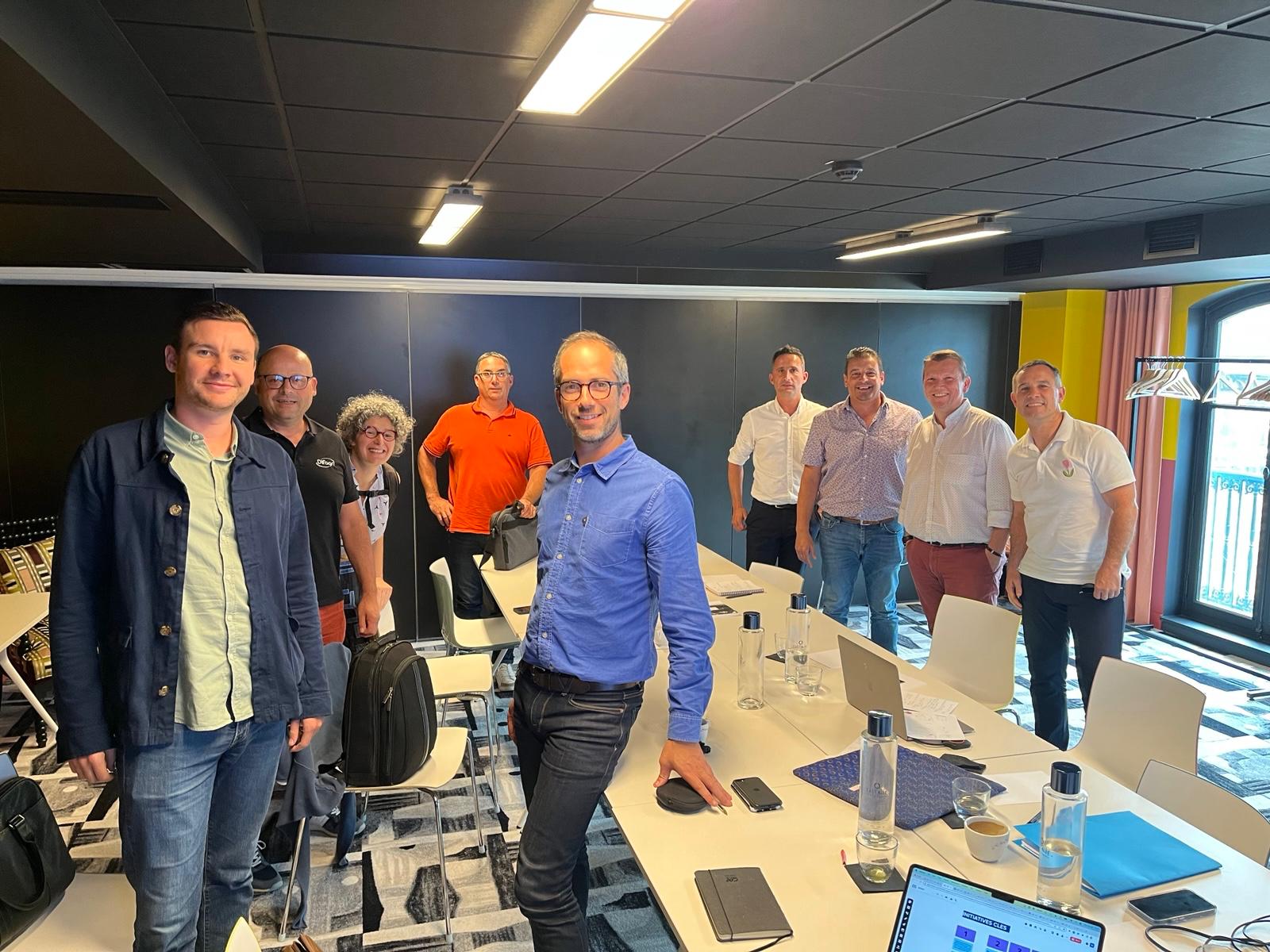
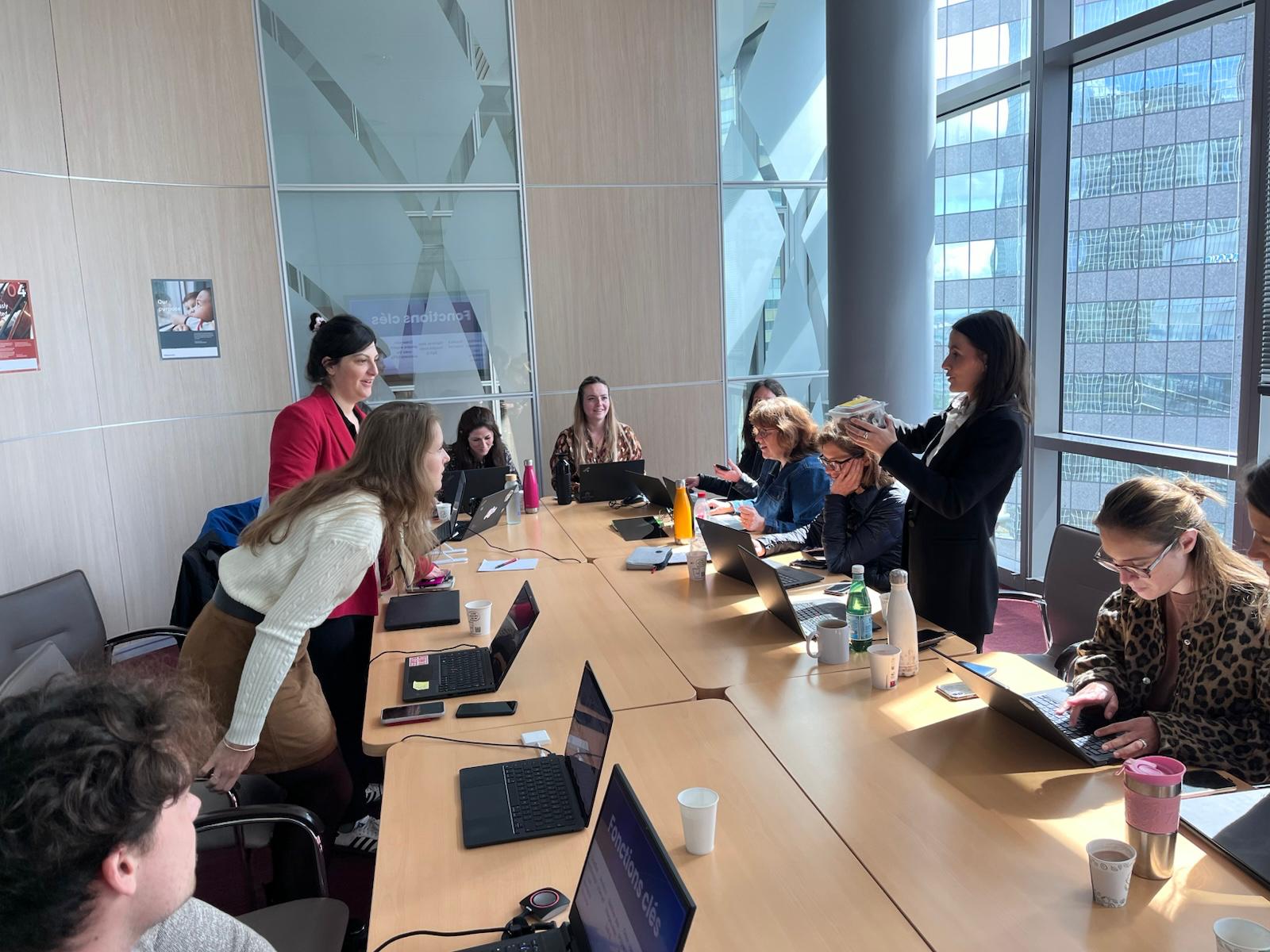
First real move: a Why–How–What workshop run by Matthieu with a cross-section of the Enov team. A method derived from Simon Sinek's Golden Circle, adapted by Catalia to AI implementation strategy in SMBs.
The logic of the workshop: you don't start with the tools (What), nor with the rollout method (How), but with the deeper reasons (Why). Why AI deserves Enov's attention, and what it should change in the practice of a research analyst.
The workshop produces two things. First, Enov's AI implementation strategy, shaped by the teams themselves, not imposed from the top. That is what makes it hold over time. Second, a community of 12 internal AI ambassadors, spotted by their engagement during the workshop, not appointed by seniority. The nuance matters: a willing ambassador pulls colleagues along, an appointed ambassador annoys them.
That community has carried the transformation inside Enov ever since. Enov's central AI lead becomes Catalia's standing point of contact on the client side.
Late 2024 – 2025: mass AI literacy, 100 people trained
Over this period, Catalia rolls out AI literacy across the whole of Enov. 100 team members trained throughout the company.
Alongside the group training, Matthieu coaches Enov's CEO directly in regular check-ins. The goal: help the CEO weigh the strategic decisions as the transformation moves forward. Which investments to prioritize? Which internal projects to launch now, which to postpone? Which commercial positioning to own in front of clients in the middle of the shift?
Executive coaching is one of Catalia's most distinctive moves: no integrator, no freelancer, no traditional firm fills that role.
2025: Catalia's automation tools
Catalia builds Enov's internal automation tools, the ones that free up research analysts' time on repetitive tasks. Technical stack used: n8n (orchestration of AI workflows) and Make (cross-application automations).
These tools are not delivered turnkey: they are co-built with Enov's AI ambassadors, so that maintenance and evolution stay in-house. That is an explicit condition Catalia set from the start. A client who depends on its provider to evolve its tools is not autonomous, it is captive.
The moment that embodies the impact: when Enov becomes a product company
This is the culmination of the transformation, and the moment of truth for the Catalia model.
Rather than building the Synthetic Personas product in Enov's place, Catalia transmits the ability to build it. Sami Mhidia guides Enov's teams technically through the design, the architecture and the validation. But the product itself is designed, developed and brought to market by Enov.
This nuance is central. A traditional consulting firm or integrator would have built the product for Enov, billed it, and kept the intellectual property or the key skills. Enov would have stayed dependent for every update.
Catalia makes the opposite choice. Our job is not to keep the value for ourselves, it is to transmit it to the client. The Synthetic Personas product is now a full commercial offering in Enov's portfolio, placing the firm among the product innovation companies in French market research.
Enov's CEO summed up at the end of 2025 what this engagement produced: sensing from the start that AI would shake up the industry pushed him to get guidance very early from Catalia's teams, on strategic consulting, on adoption by the teams, and on technical rollout, in order to stay in the race. The 360° guidance from Catalia's teams, in his words, delivers a better return on investment, fitted to Enov's roles and to the specifics of an SMB.
The Catalia team mobilized at Enov
Four people took turns on the engagement depending on the topics and availability:
- Matthieu Sabourin, founder of Catalia, as strategic lead and direct coach to the CEO. Continuous steering of the transformation across the twenty months.
- Sami Mhidia, CTO of WeAreCasus, RAG expert in regulated environments, brought in on the advanced technical modules and the architecture of the Synthetic Personas.
- Samuel De Queiroz, AI literacy and hands-on prompting modules.
- Louis Darques, applying AI to commercial and marketing processes.
This is what Catalia calls its freelance community by vertical model: not a firm with fixed headcount, but a specialized collective assembled per engagement. The client gets the right expertise at the right moment, without paying for an oversized permanent structure.
For SMB leaders watching their clients become their competitors
Enov is 100 people. If you lead a smaller SMB (30 people, 60 people), the logic doesn't change, the intensity adapts.
The Enov story now generalizes to any service SMB whose clients are starting to internalize, thanks to generative AI, what they used to buy. Research firm, creative agency, consultancy, media agency, administrative services provider, accounting firm, law firm: the same lateral threat runs through every knowledge-driven service trade.
The Catalia answer comes in four moves. A strategic assessment for the CEO: not an IT audit, but a framing of the transformation against a business model in the middle of shifting. A community of internal ambassadors, so the teams carry the transformation instead of enduring it. Co-built automation tools, so technical autonomy stays in-house. And executive coaching that lasts over time, to weigh decisions as they come, in an environment where certainties only hold for six months.
What this case says about Catalia
Enov's CEO asked the right question in September 2024: how do you make sure your institute's value is always different six months from now?
The answer is not a tool. It is not a training course either. It is a continuous transformation of practice, sustained over time by a partner who does not keep the value for itself but transmits it to the client.
That is what Catalia did at Enov for twenty months. That is what Catalia does, at different intensities, for each of its executive clients.
At Catalia, we don't teach you to produce with AI. We teach you to think with it.
Catalia services deployed on this case
Want to go further on this topic?
Let's talk about your needs.