
"One of the most appreciated trainings at SFR in a long time."
Training Department, SFR
The comfortable compromise SFR refused
The AI training industry in 2024 rested on a comfortable compromise: teach the workforce to use Copilot, three days, back to the desk, box checked. This approach transformed nothing. It only let many write in their reports that their teams were AI-trained.
At SFR, the head of skills development and training, alongside the IT modernization director, refused this arrangement. Microsoft Copilot was the official tool. Impact, the internal Gemini-based tool built by the IT teams, was rolling out. And yet, like in any 8,000-employee organization, shadow IT existed: ChatGPT used on the side, sometimes with sensitive data that should never have gone into it.
Their brief was not to train on Copilot. It was:
- Build AI literacy across the teams on generative AI while facing real-world conditions head-on (including ChatGPT use by employees) to teach them to secure it rather than deny it.
- Surface real use cases in the training, raised by the teams themselves, department by department, then ready for IT to scale inside Impact.
- Uphold standards worthy of SFR over time. Not one module, a full program.
This unusual request tipped the Catalia engagement that began in December 2024.
Why Catalia, over the twenty other options on the market
The head of training selected Catalia on what SFR called the integrity of its positioning:
- Catalia's refusal to deliver a Copilot-only AI training, knowing that ChatGPT exists and that employees already use it.
- A willingness to teach people to secure their ChatGPT use rather than deny it, in strict compliance with SFR's AI charter.
- And at the same time, to carry the IT message: bring usage back into Impact, into Copilot, into the secured internal environment, as the tools mature.
This integrity is not a slogan. It shows in every session, and it sets Catalia apart from a standard training provider caught in the market's compromise. Catalia holds the full day on-site, in groups of 8 to 12, across 100 days and 12+ departments, for 2.5 years. No quality break, no shortened format, no subcontracting.
The SFR × Catalia triangle: Training Department × IT Modernization
The strength of the program rests on a rare alignment. Three players, one shared line of sight:
- The head of skills development wants training that is useful, memorable, rooted in the work itself. Not a generic Copilot module.
- The IT modernization director wants to scale AI applications inside a controlled environment (data confidentiality, application governance, clean IT integrations), without having to frame everything in a vacuum.
- Catalia brings the teaching, the content, and above all the ability to surface high-potential business use cases during the sessions, then hand them to IT in a format ready to scale.
This triangle avoids the classic large-company pitfall: AI training and AI scaling run in parallel, then short-circuit each other. At the end of a Catalia session at SFR, it is not only 12 employees trained. A structured deliverable also goes back to IT, qualifying the use cases that surfaced, their potential, their feasibility.
Catalia entered SFR through a pilot group in the Marketing department, on the recommendation of the former Marketing director. The selection was led by the head of training. The Marketing engagement held, then extended to more than a dozen different departments over 2.5 years.
The Catalia teaching method: recursive, vicarious, end-to-end
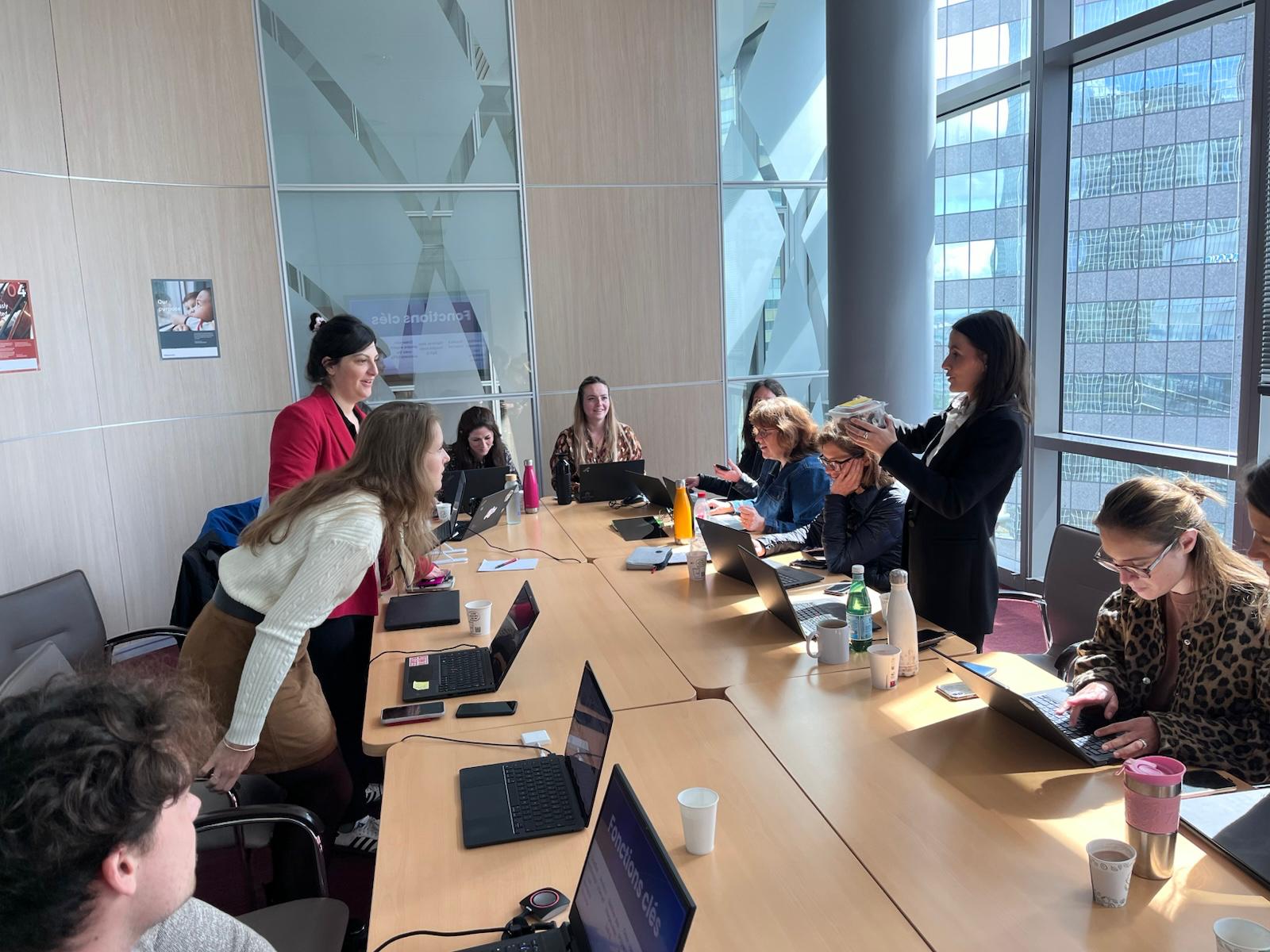
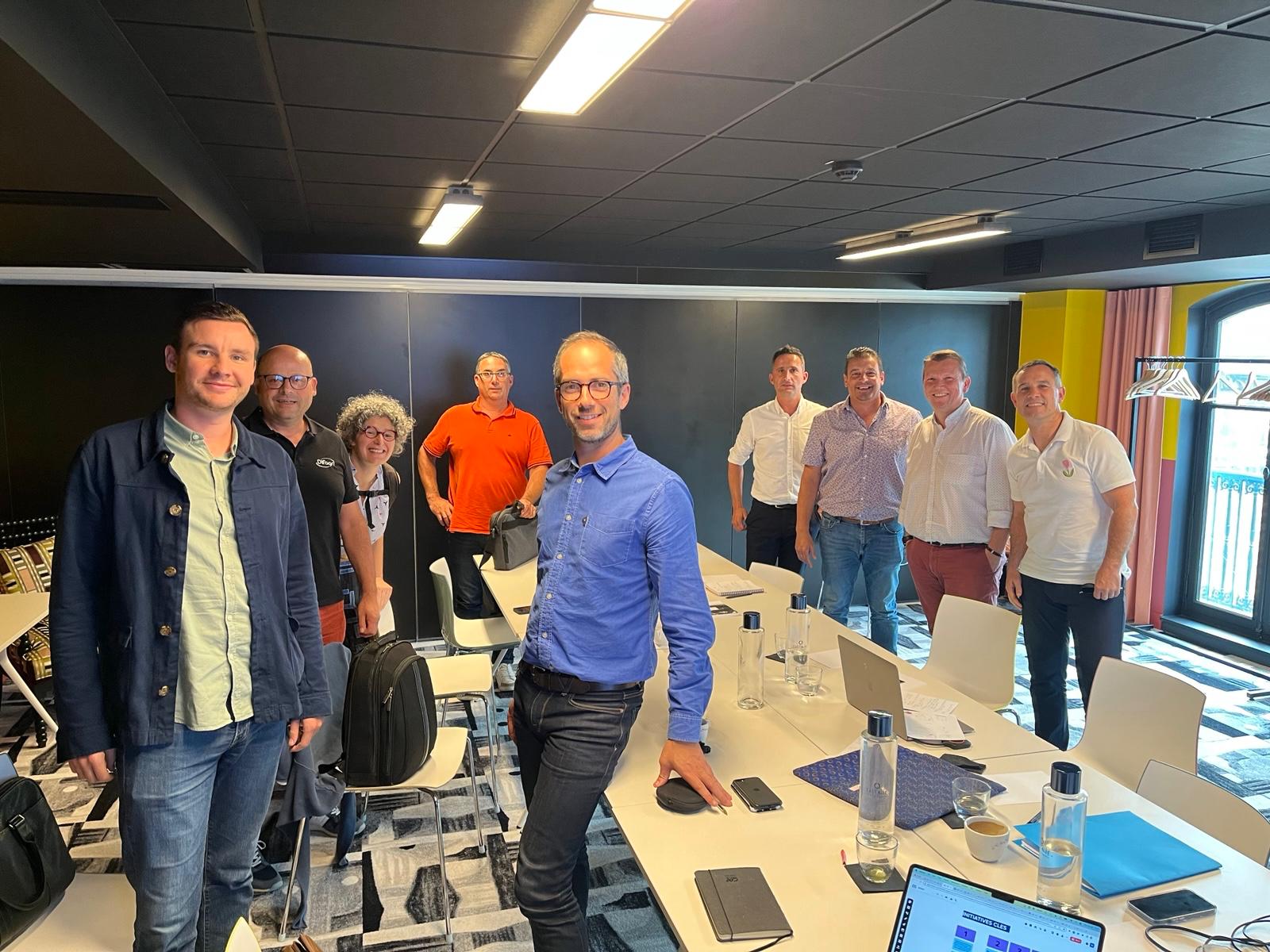
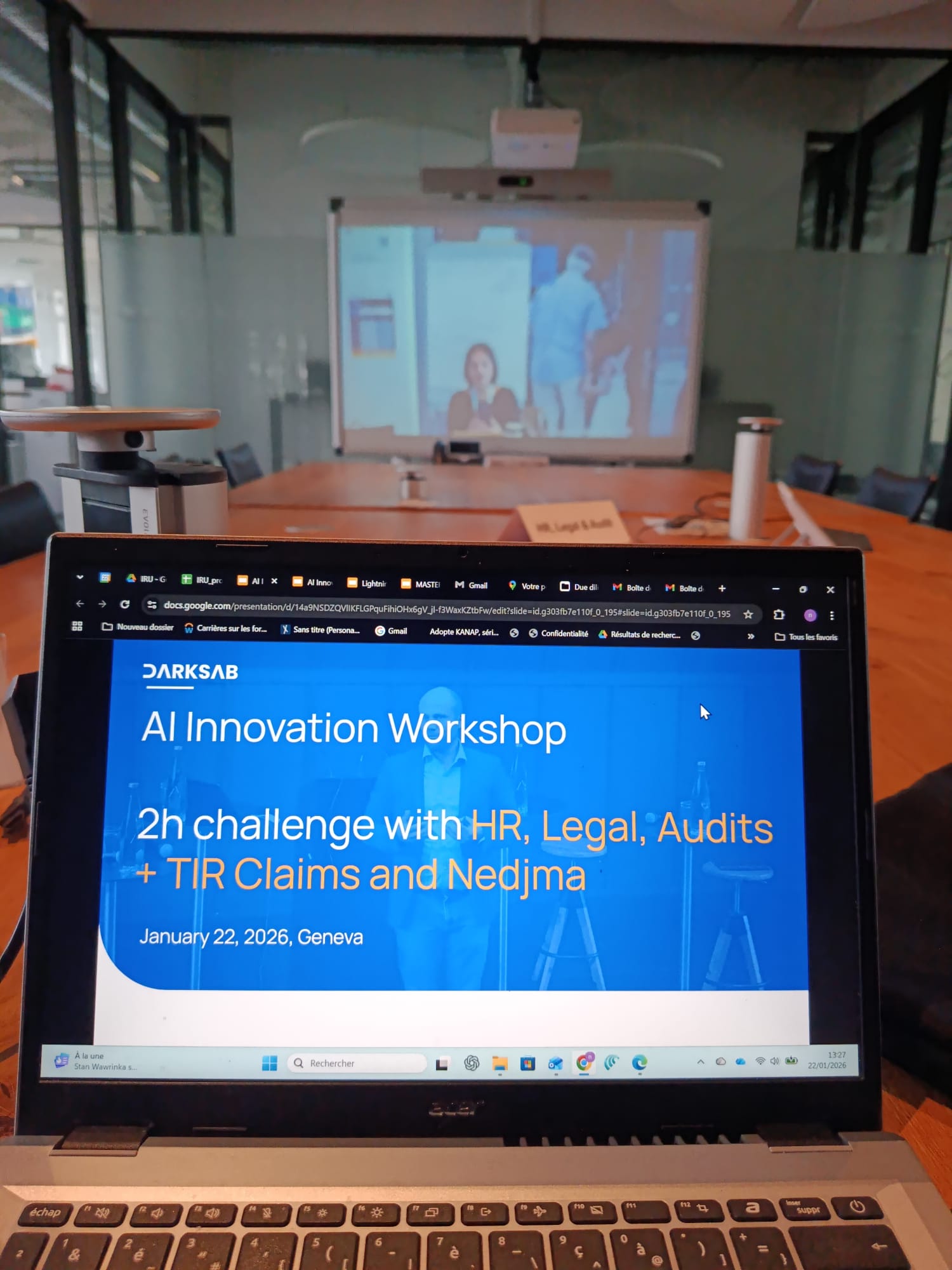
Typical format: a full day on-site, in groups of 8 to 12 people. We refuse remote training and short literacy formats: a deliberate methodological choice.
A Catalia session runs in five beats, rooted in the cognitive science of learning. We start by laying out the essential concepts of generative AI, without misleading simplification. We then show what other employees have already solved with AI, because we learn a great deal by observation: social cognitive theory in action. Next we switch into guided business brainstorming: what can AI transform in the participants' real day-to-day? Not in the abstract. Then comes recursive coaching, where we iterate on the use cases that emerge to raise their quality and shrink their blind spots, drawing on prompting techniques Catalia has built up over three years. The session ends with an integrated demonstration: for each use case identified, we show what is feasible today inside the secured environment (Copilot, Impact), and what calls for dedicated IT work to scale.
Every session is run solo by one Catalia trainer, with no second facilitator. A choice of cost efficiency for the client, and a choice of teaching coherence: one thread held across the day, no shift in posture.
A strong requirement at SFR: our trainers are at once technicians current on the latest solutions (Copilot, Impact, ChatGPT, internal agents) and trained in the emotional intelligence it takes to talk to employees about AI's impact on their jobs. This dual skill is not optional, it is required of every person who runs an SFR session.
The moment that shows what the engagement really produces
During a session for SFR's IT teams, an engineer who specializes in network equipment monitoring takes part in the workshop. Six months earlier, he had built, with a four-person team, a log-analysis tool to anticipate certain complex network failures.
In fifteen minutes, during an advanced prompting workshop, he reproduces the result with an AI agent. Better still: the agent suggests angles of correlation between log events that his team had not thought of in six months.
Six months × four people = roughly 480 person-days. Fifteen minutes to reproduce the result, and then some.
This is not a story about saving time. It is a shift in professional practice. And that is what SFR comes to Catalia for: not a training kit, but access to a new cognitive posture.
The Impact AI agent catalog: the handover works
From the raw material brought back by the Catalia sessions, SFR's IT teams built, with full technical autonomy, a catalog of specialized AI agents on Impact (the internal Gemini-based LLM), available to all employees. A few examples:
- Automated meeting notes
- Verbatim analysis (customer, internal)
- Application screening for recruitment teams
- Network equipment log analysis (the use case that started at 15 minutes in training, now scaled)
Employees reach advanced AI tools, in an environment where data confidentiality is guaranteed, without having to learn to build their own complex prompts. This is what Microsoft Copilot, used on its own, does not allow. And what Catalia, with SFR's IT teams, made possible.
Voices from the ground at SFR
"These exchanges are essential to keep guiding employees toward the right use of AI, and Impact in particular."
Feedback from an IT team member after a joint session.
"The team was very satisfied with the quality of the trainer. We sincerely hope a follow-up will be offered for level 2."
SFR team manager at the end of a training session.
"A big thank you for the wonderful day spent together. A great moment shared with you and the whole team!"
SFR participant.
The most telling signal, though, is in no report. It is in the staff restaurant at SFR's headquarters, where Jason Chevrier, a Catalia trainer who has done a great deal of work on the engagement, is stopped every two minutes by former participants who come to thank him, and to tell him how much the training still serves them.
The Catalia team at SFR
Six trainers took turns over time:
- Matthieu Sabourin, founder of Catalia, leading the teaching and strategy on the engagement
- Samuel De Queiroz, AI literacy and hands-on prompting modules
- Cindy Fontenas, cross-functional training, expertise in support functions
- Jason Chevrier, intensive sessions at headquarters, one of the most frequently rebooked trainers
- Émilie Mazoué, training for business functions
- Nedjma Fellahi, training for strategic functions
All deployed as solo trainers, all trained in the dual register the SFR brief requires: AI technical skill and emotional intelligence. A direct application of Catalia's freelance-community-by-vertical model: not a firm with a fixed headcount, but a specialized collective assembled per engagement.
For SMB and mid-market leaders
The SFR lesson does not transpose mechanically to a 30-person SMB. SFR has 8,000 employees, several departments, two official AI tools running in parallel. An SMB will never roll out this program.
But the SFR case says something more useful to an SMB or mid-market leader: if Catalia upholds the high standards of a group like SFR, with employees who are highly skilled, highly demanding, sometimes highly critical, then the level of quality you will get in your own organization is in a different league from what a generalist training provider learning on the job will offer you. To frame what you really expect from AI in your organization, a round of strategic consulting up front often helps set the right priorities before any rollout.
The SFR case is our certification by demand. It proves three things. First, Catalia sustains a long engagement, to high standards, with no quality break over 2.5 years. Second, Catalia has the methodological depth and the range of trainers to absorb varied contexts: in practice, we know how to meet your specific business reality, whatever it is. Third, Catalia keeps the integrity of its positioning even under commercial pressure, and that is the rarest criterion on this market.
If you want to start with a read on your teams' AI maturity before framing a program, an initial AI audit is often the right entry point.
What this case says about Catalia
The head of skills development and the IT modernization director made AI training at SFR something other than a box to check. They made it a strategic channel to surface use cases ready for scale. Catalia upheld those standards over 2.5 years, with no quality break, in a program that neither a standard training provider nor a SaaS integrator knows how to produce.
The lesson is not in the volume. 100 days of training, 1,000 employees, 12 departments: these numbers speak to SFR, they do not transpose to an SMB. The lesson is in the posture. The refusal of the easy compromise. The integrity of the positioning. And the ability to sustain a long program with trainers all calibrated to the same standard, on AI technical skill as much as on emotional intelligence.
This is what Catalia frames and scales inside its Academy. This is what every one of its executive clients lives, at varying intensities.
At Catalia, we don't learn to produce with AI. We learn to think with it.
Catalia services deployed on this case
Want to go further on this topic?
Let's talk about your needs.