

In many SMEs, AI shows up in daily work before any shared line has been drawn. One employee uses it to prepare a summary, a manager to structure a note, a team to accelerate certain repetitive tasks. Very quickly, the same question surfaces: what are we allowed to do, with which tools, and how far?
That is precisely the role of a corporate AI charter. It sets shared reference points on authorized solutions, information not to expose, the level of verification expected, and the situations that need arbitration. The goal is not to lock down practices — it is to avoid improvisation.
Guide: AI charter for SMEs and mid-market companies
7 essential sections, concrete examples, and writing advice to set a clear frame in your organization.
Download the template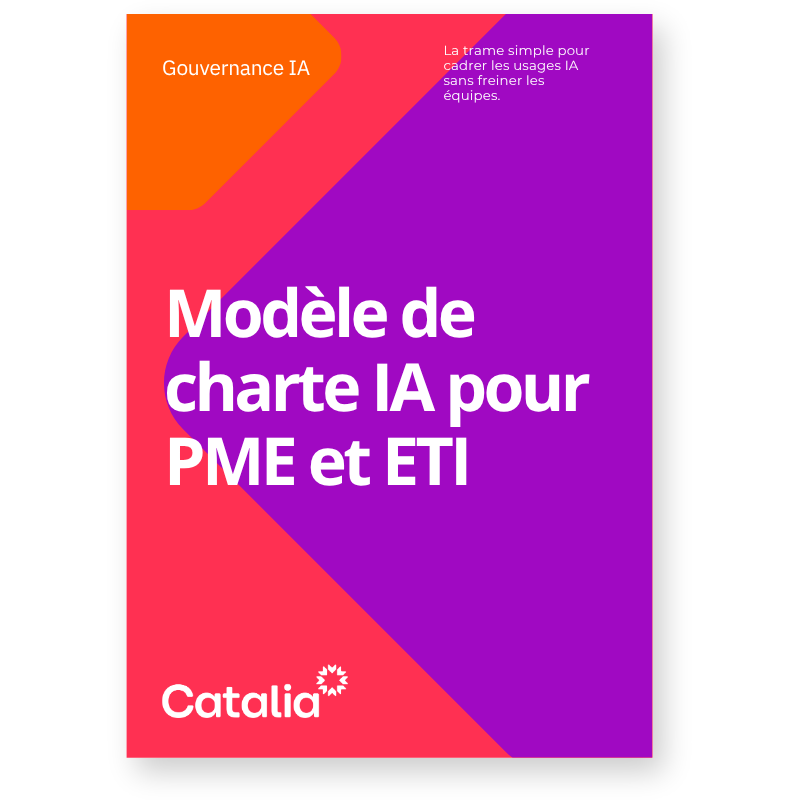
Why an AI charter becomes useful inside a company
When everyone moves their own way, the gaps widen fast. Some copy sensitive data into a consumer assistant, others take answers at face value without enough distance, others again give up on using AI for lack of legible rules.
After a few weeks, the same symptoms show up:
- disparate habits across teams
- doubts about what is allowed
- content produced too quickly
- managers arbitrating case by case
- a leadership team that senses the topic is moving without really steering it
The AI charter brings order back. It sets a common base, reduces the gray zones, and helps everyone work with more judgment.
What an AI charter should frame
A good charter does not need to be long. But it has to be sharp on the points that matter.

Authorized solutions
Not every AI application should be used the same way. Specify which ones are validated by the company, which are tolerated under conditions, and which are off-limits.

Information to protect
This is often the real knot. The charter must say clearly what can be entered, what must be anonymized, and what must never be shared in an external tool.
Encouraged practices
A well-built charter is not just a list of bans. It can also name relevant uses: prepare an outline, rephrase a text, summarize a meeting, generate ideas, structure a piece of research.

Sensitive zones
Some situations need more care: external communication, HR data, contracts, financial information, high-impact decisions, responses sent to clients.

Expected verification level
An AI-generated text is not automatically reliable. The charter must remind everyone that human control stays necessary, with a standard proportionate to the stakes.

Accountabilities
When a response is sent, a document released, or a decision made, accountability stays human. This point must be stated without ambiguity.
The 7 steps to draft a simple AI charter
Here is a pragmatic method to write a first version without spending months on it.
1. Start from the field
No need to start with a big theoretical document. The most effective path is to observe practices already in place: who uses what, for which needs, with which reflexes and which hesitations.
2. Spot the points to watch
Not every company has the same weak spots. For some, the main topic will be confidentiality. For others, it will be content quality, external communication, or consistency across departments.
3. Define what is allowed
A charter quickly becomes illegible when it only lists bans. It must also say what the company considers acceptable, relevant, and worth testing.
4. Set a review rule
This is one of the most concrete points. Who reviews what? In which cases is a light check enough? In which cases is a deeper validation needed? This rule avoids a lot of misunderstandings.
5. Name a point of contact
When an employee hesitates, they need to know who to turn to. Without a named referent, doubts stay unresolved and everyone improvises in their corner.
6. Write short
A ten-page charter has little chance of being read. A concise text, in accessible language, will be much easier to bring to life.
7. Plan an update
AI moves fast, and so do needs. A solid first version with regular adjustments beats a frozen document treated as final.
Example of an AI charter outline
For an SME, this kind of structure works well.
Template
Typical outline of a corporate AI charter
Purpose of the charter
Explain in a few lines why this document exists: give reference points, secure practices, harmonize habits.
Scope of application
Specify who is concerned, in which contexts the charter applies, and which solutions are covered.
Authorized practices
List the situations where AI can be used as a work support.
Limits to respect
Identify the data to protect, the uses to avoid, and the precautions to take.
Human verification
Remind everyone that no content or result should be taken blindly.
Roles and arbitration
Indicate who answers questions, who validates exceptions, and who decides in case of doubt.
Review of the charter
Plan a periodic update to adjust the text to real practices.
Mistakes that tense up the teams
Some charters fail less because of their intent than because of their wording.
A too-defensive charter: when the document reads like a list of potential sanctions, it creates distrust. Employees see it as a brake, not a reference point.
A too-abstract charter: general phrases like "use AI with caution" are not enough. Teams need concrete examples and legible criteria.
A charter disconnected from reality: if it does not match functional habits, it loses credibility on the spot. A charter must start from the company's real life, not from a detached ideal.
An endless charter: the heavier the text, the less it circulates. A short, well-structured, easily appropriable document is better.
A charter written without dialogue: when leadership writes alone without taking the field's pulse, it risks missing the real friction points.
A single AI charter or one per function?
In most SMEs, the right starting point is a shared AI charter for the whole company. It sets the fundamentals: validated tools, data to protect, review rule, final accountability.
Then, depending on the maturity level, it can be relevant to add complements for certain functions:
- communication and marketing
- HR
- sales
- leadership
- customer support
- finance or legal
The point is not to multiply documents too early. A shared base, then targeted precisions where needs become more specific, works better.
When to get support
Some companies can write a first charter on their own. Others save time by getting help, particularly when:
- several teams already have different practices
- managers don't know how to approach the topic
- sensitive data is in play
- leadership wants to move forward without killing the momentum
- the document needs to fit inside a broader training or rollout effort
The value of support is not just in the writing. It is mainly about starting from concrete situations, clarifying the zones of tension, and building a guideline that is genuinely applicable.
What to remember
A corporate AI charter is not meant to complicate work. It is meant to make things more legible. It gives shared reference points, avoids the most common missteps, and helps teams move forward with more perspective.
The most important thing is not to produce a perfect document on the first try. The most important thing is to set a clear base, concrete enough to be used right now, and then let it evolve with the company.
Need clarity before drafting your AI charter?
Let's talk about your needs.